













There’s a shift happening in the highways sector, and Traffex 2026 made it impossible to ignore.
Walking the floor at CBS Arena in Coventry last week, speaking with local authority teams, joining panels alongside peers across parking and digital infrastructure, the conversation had a different texture to previous years. Less “where is this all heading?” and more “show me the numbers, show me the cost, show me how this fits into what we’re delivering in the next 18 months.”
AI, enforcement technology, EV infrastructure, traffic order digitalisation, and across all of it, local councils arrived with sharper questions, tighter briefs, and very little patience for the abstract.
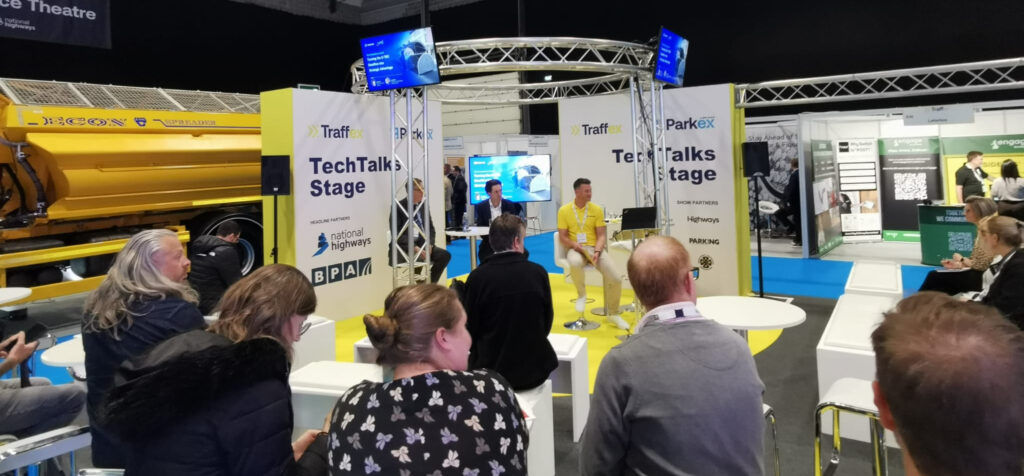
AppyWay’s session in the TechTalks Theatre, Traffex 2026
The Vibe Has Changed
We’ve been attending this event for the past 8 years. In the past, the event used to feel like a showcase of what could be. Innovative pilots, emerging technology, and a lot of strategic discussion about the future of roads. Plenty of enthusiasm. Not always a clear line back to the budget spreadsheet.
This year felt categorically different. The focus switched from products to digital solutions. And questions from local authority attendees weren’t “what’s possible?” – they were “what does this cost to run over five years?”, “how do we procure this against our existing frameworks?”, and “what’s the realistic ROI, not the best-case scenario?”
The Compliance Crunch: A Conversation Worth Having in Public
Our fireside chat in the TechTalk Theatre – “The Compliance Crunch: Turning the D-TRO Deadline into Strategic Advantage”, featured Tom Robison, Programme Policy Manager at the London Borough of Southwark, sharing what the journey from analogue to digital actually looks like in practice.
The before picture was familiar to most in the room: text-based orders taking close to a month to complete, officers measuring distances on-site, and members of the public having to visit the office in person to view restrictions. Since digitising through Traffic Suite, that process takes less than half the time, and Southwark didn’t stop at parking. They brought on-street, off-street, temporary orders, estates, and enforcement into one system, cutting legal challenge risk and giving the public a map they can actually use.
When asked whether they’d have done it without the D-TRO mandate, Tom was unequivocal: “100% — because the cross-council benefits are immense. Keeping your essential staff happy is the most important thing going.”
The full recording will be available on demand shortly.

Our famously yellow stand was busy throughout both days of the event, Parkex/Traffex 2026
Show Me the Evidence
Beyond our own session, the questions being asked on the floor reflected a sector in genuine transition, and a few patterns stood out.
The data infrastructure problem is real and widely acknowledged. Across sessions, including AppyWay’s Jyoti Goyal’s panel on coordinated kerbside management, a consistent theme emerged: fragmented datasets and inconsistent data quality remain the single biggest barrier to connected mobility. Whether you’re talking about AI-assisted enforcement, EV charge point integration, or digital traffic orders, the underlying problem is the same. You cannot build intelligent, responsive streets on top of analogue or siloed data.
Teams on the ground want to see their working lives improve. Not just their authority’s compliance status or their senior leadership’s strategic objectives. One of the most important questions we put to Tom in our fireside chat was whether engineers and parking officers were seeing their day-to-day work get easier since digitising traffic orders with Traffic Suite. The answer matters, because digital transformation that only registers at a strategic level tends not to stick, and councils know that now.

Panel: From Chargepoints To Coordinated Kerbside Management, featuring AppyWay’s Jyoti Goyal , Traffex/Parkex 2026
The Pavement Parking Wake-Up Call
The government’s recent consultation response about the pavement parking legislation wasn’t on the official agenda, but it dominated customer conversations on the Parkex/Traffex floor.
Councils we spoke to felt relief and alarm in equal measure. No overnight blanket ban, but now they must make active, defensible decisions about every street. And they can’t do that without knowing what’s already there. For too many, that information still lives in PDFs and institutional memory. Traffic Suite and the ANPR mapping we offer at AppyWay change that, giving authorities a digital foundation to make policy on top of reality, not guesswork. (Reach out to keith.kelly@appyway.com to request more info)
The Opportunity Window Is Now
There’s an honest observation worth making here. Councils that move in the next few months will be building for strategy. Councils that wait until the end of 2026 will be rushing for compliance.
Those are meaningfully different positions to be in. One gives you time to think about data quality, team training, integration with enforcement and asset management, and the full ecosystem of digital traffic order management. The other gives you a deadline.
At AppyWay, we’ve seen both play out. The councils that get the most from Traffic Suite and from digitisation more broadly, are the ones who treat it as a transformation of how they manage and deliver a critical public service, not just a regulatory hurdle to clear.
The D-TRO mandate is real. The deadline is approaching. But the opportunity it represents is larger than the compliance requirement, and Traffex 2026 made clear that the most forward-thinking local authority teams already know that.
The full recording of “The Compliance Crunch: Turning the D-TRO Deadline into Strategic Advantage” with Tom Robison will be available on demand shortly. If you’d like to talk to the AppyWay team about your authority’s D-TRO readiness, get in touch.


